|
|
the-south-asian.com April 2005 |
|
|||
|
|
|
||||
|
The Chandra Mission - 5 years in space
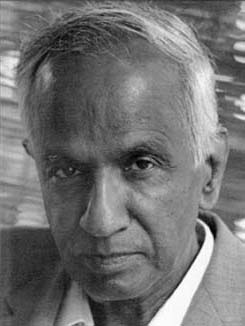
CHANDRA: The Man behind the Name Subrahmanyan Chandrasekhar (1910-1995). Subrahmanyan Chandrasekhar was one of the foremost astrophysicists of the twentieth century. He was born in Lahore, then a part of British Colonial India, to Sita Balakrishnan and Chandrasekhara Subrahmanya Ayyar in Oct 1910. Trained as a physicist at Presidency College, in Madras, India and at the University of Cambridge, in England, he was one of the first scientists to combine the disciplines of physics and astronomy. Early in his career he demonstrated that there is an upper limit to the mass of a white dwarf star. This limit – now called the Chandrasekhar limit – showed that stars more massive than the Sun would explode or form black holes as they died. A white dwarf is the last stage in the evolution of a star such as the sun. When the nuclear energy source in the centre of a star such as the sun is exhausted, it collapses to form a white dwarf. This discovery is basic to much of modern astrophysics, since it shows that stars much more massive than the sun must either explode or form black holes. Chandra migrated in 1937 from India to the United States, where he joined the faculty of the University of Chicago, a position he remained at until his death. He and his wife became American citizens in 1953. Chandrasekhar was elected to the Academy only two years after he became a US citizen. He was noted for his work in the field of stellar evolution, and in the early 1930s he was the first to theorize that a collapsing massive star would become an object so dense that not even light could escape it. Although this finding was greeted with some scepticism at the time it was announced, it went on to form the foundation of the theory of black holes, and eventually earned him a shared Nobel Prize in physics for 1983. In addition to his work on star degeneration, Chandrasekhar contributed important theorems on the stability of cosmic masses in the presence of gravitation, rotation, and magnetic fields; this work proved to be crucial for the understanding of the spiral structure of galaxies. From the time he came to the US in 1936 until his death in 1995, Chandrasekhar was affiliated with the University of Chicago and its Yerkes Observatory. Chandra also developed theories on star atmospheres, black holes, illumination of the sunlit sky, star structures and star mass. In 1983 Chandra was awarded the Nobel Prize in Physics for his work on the physical processes involved in the structure and evolution of stars. Chandra published ten books and served as the editor of the prominent Astrophysical Journal for nineteen years. In 1999, four years after his death in August of 1995, NASA launched Chandra, an x-ray observatory named in honour of Subrahmanyan Chandrasekhar. The observatory studies the Universe in the x-ray portion of the electromagnetic spectrum. Chandra was a popular teacher who guided over fifty students
to their Ph.D.s. His research explored nearly all branches of theoretical
astrophysics and he published ten books, each covering a different topic,
including one on the relationship between art and science. For 19 years, he
served as editor of the Astrophysical Journal and turned it into a
world-class publication. Chandra Facts
The Chandra X-ray Observatory helps astronomers worldwide
better understand the structure and evolution of the universe by studying
powerful sources of X rays such as exploding stars, matter falling into
black holes and other exotic celestial objects. X-radiation is an invisible
form of light produced by multimillion degree gas. Chandra provides x-ray
images that are fifty times more detailed than previous missions. At more
than 45 feet in length and weighing more than five tons, it is one of the
largest objects ever placed in Earth orbit by the Space Shuttle. NASA's Chandra X-ray Observatory, which was launched and
deployed by Space Shuttle Columbia on July 23, 1999, is the most
sophisticated X-ray observatory built to date. The Observatory has three major parts: (1) the X-ray telescope, whose mirrors focus X-rays from celestial objects; (2) the science instruments which record the X-rays so that X-ray images can be produced and analyzed; and (3) the spacecraft, which provides the environment necessary for the telescope and the instruments to work. Chandra's unusual high Earth orbit., which has the shape of
an ellipse, takes the spacecraft more than a third of the way to the moon
before returning to its closest approach to the Earth of 16,000 kilometres
(9,942 miles). The time to complete an orbit is 64 hours and 18 minutes. Chandra has begun an exploration of the hot turbulent regions in space with images 25 times sharper than previous X-ray pictures. Chandra can enable astronomers to study the process by which jets of matter are ejected from supermassive black holes in the dense central regions of galaxies. Chandra's improved sensitivity can make possible more detailed studies of black holes, supernovas, and dark matter and increase our understanding of the origin, evolution, and destiny of the universe. Text courtesy: chandra.harvard.edu chandra.nasa.gov ***** |
|||||
|
Copyright © 2000 - 2005 [the-south-asian.com]. Intellectual Property. All rights reserved. |
|||||